Fishing for Ghosts
Fly fishing, bonefish, and a lesson in humility

It’s become a bit of a tradition for Tory and I to flee Utah in the winter in search of somewhere warm. Mexico has been the destination of choice but this year we headed to Key West, Florida.
When we told friends we were vacationing in the Keys they responded with bemused smiles. Why the Keys? Mexico is right here, it’s cheaper, easier to get to, and it isn’t Florida. No one ever said that outright, it’s just what I interpreted from their tepid grins. When I told fellow anglers where we were headed however, they simply nodded with a kind of knowing smile. Because they knew the truth. We were headed to Key West in search of ghosts—grey ones in fact.
A bit of context might be in order.
The Keys hold a certain ephemeral pull for anglers that, I think, began with legends of Hemingway fishing off his boat the Pilar in the 1930’s. But for me and for fellow fly anglers, the Keys took on legendary status in the tales of authors, poets, and musicians like Jim Harrison, Tom McGuane, Hunter S. Thompson, and Jimmy Buffet from their time fishing the keys in 1960’s and 70s. I don’t know how to express to you the aesthetic pull these scions of rowdy American literature have on me. If you’ve never wanted to ride shotgun with Kerouac, I’m not sure you’ll understand the pull I feel when I see grainy photographs of Thompson, McGuane, or Harrison chasing tarpon in the 1960s.
Ever since, when trout fishing slows in winter the obsessed and the privileged head south in search of Tarpon, Permit, and bonefish—and this year, I wanted to be one of them.


I had, until this point, never even held a fly rod in salt water. But I’d watched a lot of videos. I’d seen anglers standing on the raised platform of a flats boat, fly rod bending impossibly as line screamed from the reel, pulled by the force of a forty-pound adolescent tarpon careening skyward out of the water. One video and I knew I had to try.
There are all sorts of fish you can cast a fly to in the saltwater flats of Key West. Tarpon and permit are the popular it-fish of the water. They’re big, fast, and shiny. Exactly the kind of fish vacation-dads show pictures of to their coworkers. You can also fish for barracudas, long and smelly, who fight like tarpon and possess razor sharp teeth. Technically you can fish for sharks too, but I am uninterested in playing tug-of -war with hundred-pound shredder. I had come to Key West for none of these illustrative targets, now don’t get me wrong, I wouldn’t turn down an opportunity to fish for Tarpon or Permit, but I didn’t feel I had quite earned that challenge yet. Instead, I had come to Key West for bonefish, aka the grey ghost.
If I am honest, I don’t quite understand the appeal of bonefish. I feel it but I can’t explain it. The heart wants the fish it wants. They possess none of the features that are traditionally thought to allure an angler. They are not as elegant as trout or as venerable as salmon. They’re not as powerful as steelhead and they do not fly like tarpon. On average they are a three to five pounds. They travel in small schools and are skittish, but will give chase to flies with wonderful names like Gotchas, Crazy Charlies, and Clouser Minnows—which, according to dubious wisdom, resemble shrimp or minnows.
Why then the fascination? Here are some guesses.
First. They are grey. Stay with me on this. Bonefish are grey, making them nearly impossible to see for the untrained eye, hence the nom de guerre, grey ghost.
Second. They swim. Don’t laugh. Unlike trout, bonefish are constantly moving. They don’t hold up in deep holes or sit in the current to eat. This means, unlike trout, you cannot cast to where you think a bonefish will be. And, unlike trout, you cannot repeatedly cast to them. You get one shot. One opportunity. Do not... sorry, forever a millennial. Instead, bonefish is a sport of sight casting, but that begs an important question, how do I sight cast to a skittish ghost?
Third. They are far away, requiring an angler to cast 60, 80, 100 feet. I’m from Utah and am unaccustomed to fishing a river that is even 60 feet wide. Casting for bonefish is a new skill for a trout angler, and an illustrious opportunity. You use a heavier weighted rod, with heavier line, and heavier flies, which requires learning a different cast to cover the distance. You also never leave the fly to “drift” over the fish. With trout, the drift is everything. You’re trying to imitate the way an insect naturally floats upon the water. But bonefish chase. Once your fly hits the water, you must immediately begin stripping the line to imitate a swimming minnow. Slow down or oscillate speed, and bonefish lose interest.
Fourth. They live in the ocean which means that fishing for bonefish is an activity greatly expedited by boat. The boats in question are specially designed vessels with extremely shallow drafts allowing them access to the flats. Once you’ve arrived to a flat, a favorite haunt of bonefish, guides will turn off their boats and stand on an elevated platform pushing the boat with a long pole, like you’re on a romantic venetian gondola ride where everyone is wearing sun hoodies and Oakleys. From their elevated platform the guide is on lookout for signs of fishiness—a technical term. Once they see what they are looking for, if they see what they’re looking for, they will direct the angler in meticulous code that assumes I know how to read a clock, “Eleven o’clock, one hundred and twenty feet out, start casting (to what… it doesn’t matter just do as they say), more line, cast, now strip strip, faster, strip (excuse me sir), aaah spooked em. That’s kind of how it goes, at least for me.
Fifth. Bonefish are fast. Once they take the fly, if they take the fly, and once you’ve successfully set the hook with a final strip of the line, if you set the hook—they bolt straight to Cuba taking your line with them leaving you in a daze as your line whistles from the reel.
What I’m trying to say is that fishing for bonefish is thrilling. You stand on a boat with your be-spoakledly gondolier, blind casting to skittish ghosts that swim like lightening. You’re hunting for phantoms—the chance to say hello to a specter before releasing it back to the wild.
What else could you want?
We arrived in Key West at a strange time for our planet. A once in a generation cold front had blown into Florida leaving the ground littered with frozen iguanas. The day we arrived, temperatures were nearly the same as Utah which was experiencing historic warmth. These were not ideal conditions for fishing. Like the tourists who visit, bonefish prefer water a comfortable seventy degrees, but the cold front had dropped local water temperature to the low sixties pushing the bonefish to deeper, warmer waters. The wind further complicated conditions. We were scheduled to fish Thursday, but thirty mile an hour winds turned the normally placid flats tempestuous forcing us to reschedule for Sunday. By the time Sunday rolled around conditions had improved but expectations were still low. Water temperatures were creeping towards the high sixties. Possible but not ideal conditions. Our guide—a seventh generation Conch (that’s what you call someone from Key West, which is as delightful as it sounds offensive) and third generation fishing guide—was honest about our prospects, which I appreciate in a guide. I would rather a bit of a pessimism so that if I fail, I can blame conditions rather than an optimist who leaves me nothing to blame but myself. Give me something for the story.
This is where fishing for trout and bonefish share many similarities. Expectations are a fickle thing. We all show up with expectations. It’s the expectations that got us there in the first place. But show up with too many expectations and you can expect to be disappointed. Show up with too few expectations and you may never have the faith or courage to cast again. Maybe the secret is in what you expect, in holding possibility lightly, and in the practice of honing hope.
Who knows, I was hoping for bonefish.
We arrived at the dock at 9am. The temperature was a humid sixty-five degrees which felt fine to me but was absolutely not warm enough for our guide or my wife. Our guide, a native Conch as I will continue to mention for the fun of it, was accustomed to warmer weather and arrived in full waders, parka, beanie, gloves, and face wrap—all of which Tory coveted greatly. We boated to our first location and were pleasantly surprised by the signs of fishiness. From our perch we could see sharks, lemons and bonnethead, as well as barracudas. I am new to this and wasn’t sure if this was a positive or negative sign, but our guid said predator activity was an indication of warming water, aka fishiness. Surprisingly encouraged by the presence of so many teeth our guide assumed his position on the elevated platform to search for what we had come. Thirty minutes in, he spotted a small school of bonefish. Hurrah. Oh, they're swimming away. A little while later, he spotted another. Two hundred feet out, one o’clock. I took my position on the bow of the boat, fly rod in hand waiting for instructions. Then I heard it, my time had come, my glorious opportunity to put all those hard years of fly fishing to show. One hundred and twenty feet out, start casting, more line, more line, cast, now strip… they’re gone. You gotta strip faster. Things proceeded like this for a while. Eleven o’clock, coming in fast, start casting, go, too long… you spooked em. And again. One o’clock, eighty feet out, now, aaah too short, they turned… And again. Strip strip… ahh you gotta start stripping right away.
The first two hours of fishing for bonefish was a performance in humility for an audience of two, our Conch guide and Tory who shivered behind me as I sweat under the pressure of stripping for all these beady-eyed, boneheaded, bottom feeding, shrimp eating spirits.
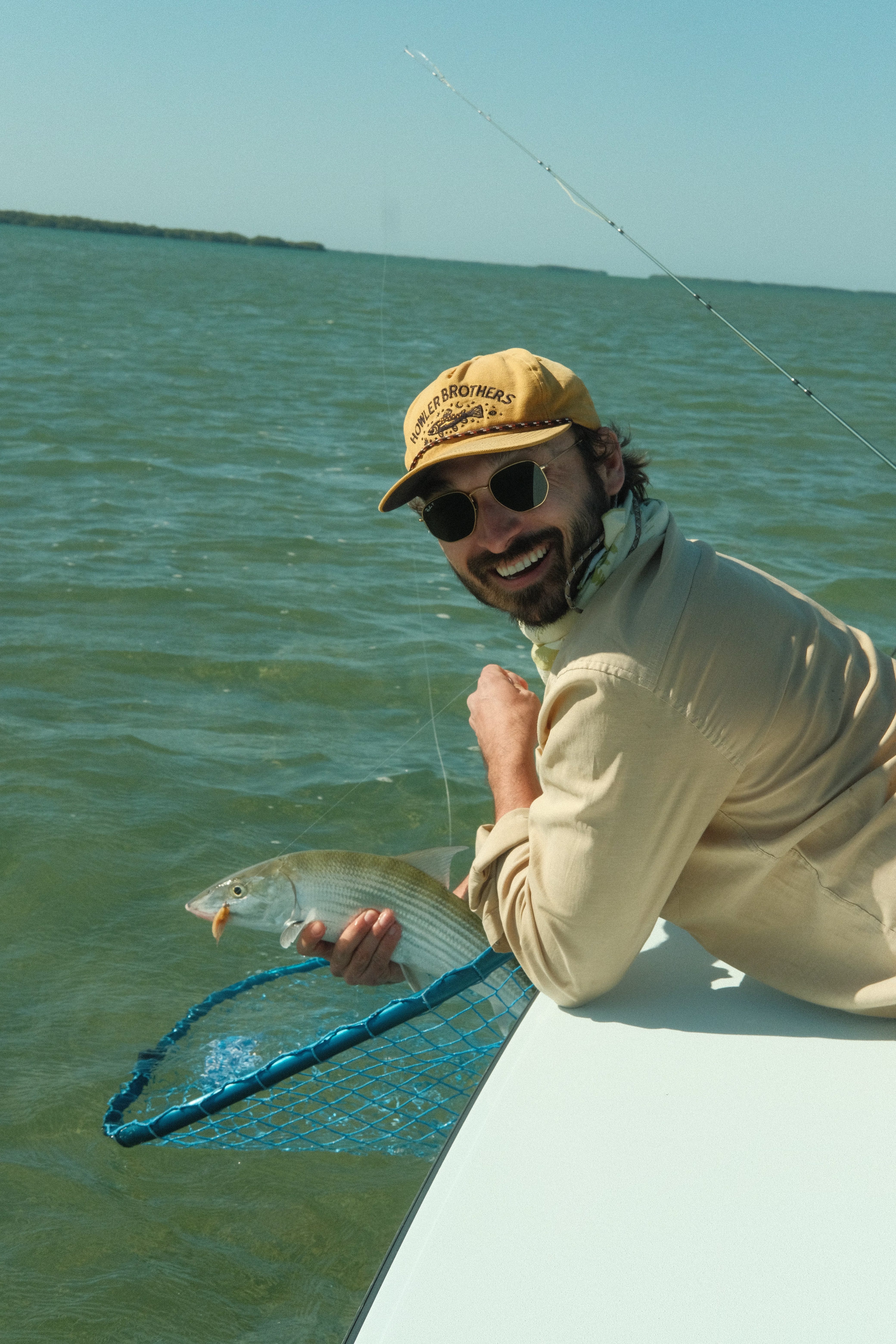
After I had successfully frightened away all the bonefish from our first flat, our guide led us to another. Again, moral was boosted by the presence of carnivores in the water and quickly our guide spotted another small school of bonefish. Our ritual commenced. But this time, this time, would be different. I had learned. I had grown. I had drank a beer. I would not leave this flat empty handed—well technically I would leave empty handed, because I want to conserve bonefish populations, but I would leave triumphant! I took my position and waited for the Conch on the stern to issue his commands. Eleven o’clock (great I know this one), a little more left (well…), one hundred feet out and swimming towards us, start casting, a little more line, cast, now strip strip, strip, he took it, long strip! Now let go. The water flashed, the rod buckled, and the line began to scream as a ghost gave chase. There was a bonefish on my line. If I wasn’t for our guide’s enthusiasm and line careening, I wouldn’t have even known what happened. The take was quick, the set subtle. But the race, the race was worth the wait. The fish made it to international waters before he began to tire enough that I could start reeling him in. Once he slowed, I’d begin retrieving line until he decided he still had some flight in him. Finally, I reeled him back to the boat, where we could safely net him and keep him hydrated without too much fear of a prison break.
And there it was, my first and… only bonefish of the trip. Expectations are a fickle thing, eh?
We fist bumped, took our photos, and released our ghost. There it was.
We fished a few more hours that day, but signs of fishiness were scarce. Even the predators had seen enough of my casting and headed to deeper water for a reprieve.
If you’ve read this far you might be wondering what the point of it all was. That’s a fair question. I don’t really know. Maybe this is story about learning something new, about sharing something you love with the person you love, or about the practice of holding expectations appropriately. I’m not totally sure.
What I do know for certain, however, is that one was not nearly enough.
Good story. I’m impressed you’re up on those 50’s and 60’s icons.